‘Pichon, in a short time has become one of the most interesting conductors in classical music.’ (New York Times)
A leader of his generation, Raphaël Pichon develops original and highly personal projects, while drawing on a rich tradition.
A leader of his generation, Raphaël Pichon develops original and highly personal projects, while drawing on a rich tradition.
Raphaël Pichon began his musical training with the violin, piano, and singing. As a young professional singer, he performed under the direction of Jordi Savall, Gustav Leonhardt, and Ton Koopman, as well as with Geoffroy Jourdain’s Les Cris de Paris.
In 2006, he founded Pygmalion, a choir and orchestra performing on period instruments. Notable projects in recent years include: the creation of Trauernacht, based on music of Bach and directed by Katie Mitchell (2014); the rediscovery and staging of Rossi’s Orfeo at the Opéra National de Lorraine and the Opéra Royal de Versailles (2016); the Vespers with Pierre Audi (Holland Festival, BBC Proms, Royal Chapel of Versailles, Leipzig Bach Festival); a staged version of A German Requiem by Jochen Sandig at the submarine base in Bordeaux; stage productions of The Magic Flute by Simon McBurney (2018); Mozart’s Requiem with Romeo Castellucci (2019); Samson, a loose recreation of Rameau’s lost opera, with Claus Guth (2024) at the Festival d’Aix-en-Provence; and Lakmé (2022) and L’Autre Voyage with music by Schubert (2024) at the Opéra-Comique.
In 2020, he created the Pulsations festival in Bordeaux. In 2024, in partnership with Arte and France Musique, he embarked on the Les Chemins de Bach project with Pygmalion, a grand journey on foot and by bicycle between Arnstadt and Lübeck.
As a guest conductor, Raphaël Pichon has conducted the Freiburger Barockorchester, Musicaeterna, the Scintilla of the Zurich Opera, the Handel and Haydn Society of Boston, the Mozarteum Orchester, and most recently the Orchestra of St. Luke’s at Carnegie Hall. The 2025–2026 season marks his debut at the Paris Opera, as well as with the Berliner Philharmoniker and the Amsterdam Concertgebouw Orchestra.
His recordings are released on the harmonia mundi label: the imaginary opera Enfers with baritone Stéphane Degout (2018), Libertà! featuring little-known masterpieces by Mozart, Bach’s Motets (2020) and St Matthew Passion (2022), Mein Traum (Schubert, Schumann, Weber—2022), Monteverdi’s Vespers of the Virgin (2023), Mozart’s Requiem (2024), Bach’s Mass in B minor (2025), and Brahms’s A German Requiem (2025).
Raphaël Pichon is an Officer of the Order of Arts and Letters.
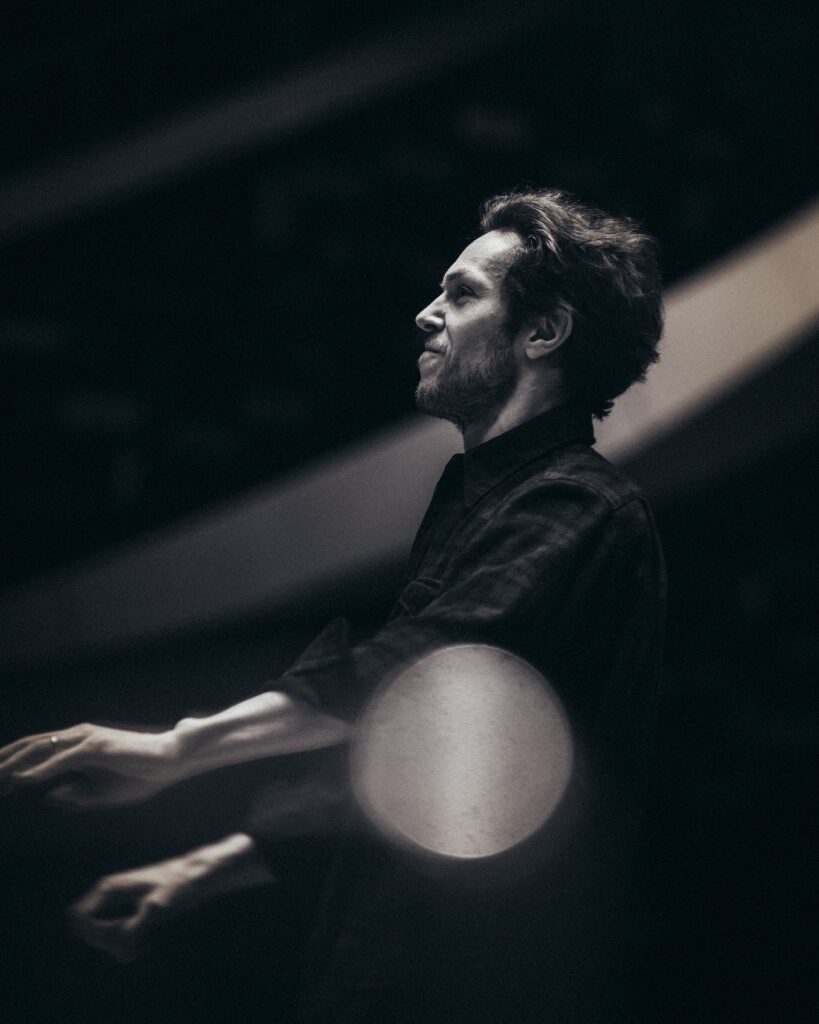
‘An iconic figure of the new baroque generation, a gifted conductor, a model of elegance.’ (Vanity Fair, Hugo Wintrebert, 2024)
‘Raphaël Pichon is on a quest to ensure that music plays its transformative part in a changing world.’ (Gramophone, Alexandra Coghlan, 2023)
‘Raphaël Pichon makes the ancient sound urgently, utterly contemporary: This is the kind of thing that we listen to classical music for.’ (The New York Times, David Allen, 2025)
‘Raphaël Pichon, artistic director and researcher, loves team spirit and mixing genres. He is one of the great contemporary conductors, as much an intellectual as an artist, an airy, friendly, sober and passionate young man, a builder.’ (Libération, Virginie Bloch-Lainé, 2025)
‘“He describes himself as a conductor-entrepreneur,” the artistic and stage director Pierre Audi said in a phone interview. “He’s somebody who is an initiator, a man of ideas.” “He’s not just a pair of hands that conduct,” Audi said, “but somebody who is thinking about programs, also about form, about theatricality, about presentation, how to make programs that are more dramaturgical. So that makes him quite unique.’ (The New York Times, David Allen, 2022)
‘Now it’s clear. Raphaël Pichon is no longer just the rising star of the baroque scene, the most promising hope for orchestral and choral conducting in France. He is quite simply unmissable. Each of his projects is carefully thought out and crafted, with the intelligence of the programme design rivalling the perfection of the performance, both in concert and on disc.’ (Le Figaro, Christian Merlin, 2018)