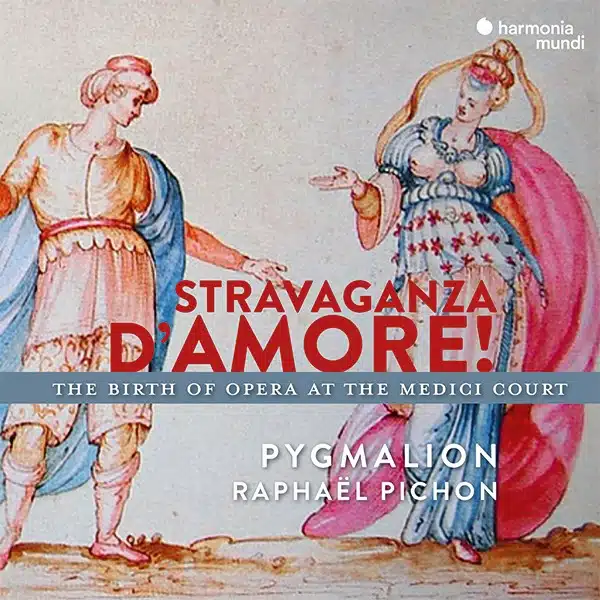
Stravaganza d’Amore!
Antonio Brunelli, Lorenzo Allegri, Giovanni Battista, Buonamente Girolamo Fantini, Cristofano Malvezzi, Giulio Caccini, Luca Marenzio, Alessandro Striggio, Sr Marco da Gagliano, Alessandro Orologio, Jacopo Peri, Emilio de’ Cavalieri
The sumptuous world of the ‘Intemedi’… Late sixteenth-century Florence was a theatre: first and foremost a political one, in the eyes of the dynasties that wished to use the arts to display their power. A humanist one too, as is shown by these intermedi (interludes) that sought to achieve the perfect blend between music and poetry, the ideal of a certain Renaissance. Inserted into plays imitating the ancient writers, these entertainments were presented with lavish visual and musical resources. After reaching an initial peak in 1589 with the intermedi composed for Bargagli’s La pellegrina, this tradition was prolonged in the burgeoning genre of opera by such composers as Peri, Caccini (Euridice, 1600) and, very soon, Monteverdi (L’Orfeo) and Gagliano (Dafne).
Rather than aiming for the impossible ideal of a reconstruction, Raphaël Pichon has devised a sort of imaginary intermedio by selecting the finest gems from this repertory, featuring the figures of Apollo, Orpheus and Eurydice, and above all Cupid: Love, Love, Love!
harmonia mundi
1 houe 42 — 2 CD — 19 May 2017
Awards


La presse en parle
‘A dazzling celebration of sounds and senses. A return to origins that is as beautiful as it is informative, thanks to remarkable editorial work punctuated with superb illustrations.’ (Jérémie Bigorie, 2017)
‘Deploying an extraordinary arsenal of weapons of seduction, Raphaël Pichon delivers a unique and fascinating work, rich in emotion… and sometimes paradoxical.’ (Denis Morier, July 2017)
‘An enchanting and fascinating return to the origins of opera, accompanied by richly illustrated and documented texts.’ (Thierry Hillériteau, 2017)
‘The performance deserves nothing but praise, as Raphaël Pichon knows how to bring these pieces to life with his lively conducting: elasticity of beat, favouring a very broad and contrasting dynamic, innate sense of structure. He can count on the commitment of his Ensemble Pygmalion, a group already well versed in this kind of exercise: the colours of the historical instruments, the beauty of the phrasing, the flexibility of the articulation, in a word, the extreme plasticity of the discourse.’ (Jean-Pierre Robert, 2017)
‘Admirably served by Hugues Deschaux and Olivier Rosset’s sound recording, Pygmalion’s performance equals, if not surpasses, that of Collegium Vocale Gent and the Capriccio Stravagante Renaissance Orchestra led by Skip Sempé.’ (Bernard Schreuders, 6 June 2017)
‘Pygmalion is exemplary in its staging and the homogeneity of the choir, as well as the flamboyance of the instrumental colours. How can one not be moved by the lamentations of Apollo or Orfeo (from Caccini’s Euridice, in which Renato Dolcini distils every sigh with profound emotion)? This journey into the past and to the origins of opera is too short.’ (Michel Parouty, 2017)